

Your cart
There are no more items in your cart


Heat shrinkable tubing made of polyolefin material
What is a Heat shrinkable tubing Polyolethin crosslinked ?
Polyolethin crosslinked is without doubt the king material of heat-retractable ducts. When we talk about " tubing In the electrical or electronic environment, it is generally referred to. Made from polymers such as polyethylene or its derivatives, which have been crosslinked (i.e. made thermo-hardened by irradiation or special treatment), tubing Polyolethin combines ease of use, insulation performance and versatility. This is the standard choice for applications ranging from insulation from simple splicing to whole beam sheathing in aerospace.
The Heat shrinkable tubing Polyolethin crosslinked : The standard of electrical insulation
Polyole sheathsthin high-quality crosslinks generally support temperatures from -55 °C to +125 °C in continuous operation. Many are UL-approved up to 125 °C. They start retracting from ~90 °C, allowing easy installation with a basic thermal gun. Some improved variants even rise to 135°C at peak. This range covers virtually all needs in the current industrial environment or in the automobile industry, except in extreme cases.
Polyolethin crosslinked has a typical dielectric rigidity around 20 kV/mm. In other words, thin a few tenths of a millimetre layer is sufficient to prevent the passage of the current under very high voltages, as long as the tubing is intact. This makes it an ideal protection for connections, wire welding or bare components – you avoid any risk of electric arc or short circuit with the chassis.
These sheaths are flexible and flexible, marrying well the shapes of objects to be covered, even angular. Once tightened, the sleeve Polyolethin does not increase the beam and tolerates repeated bends and movements without cracking. Moreover, thanks to the cross-linking, it does not melt if it is slightly overheated when placed : It contracts without liquefying, avoiding holes or tears, the wall remains continuous. It is resistant to abrasion and offers additional mechanical protection to the wires around it.
Most polyolefin sheaths sold are formulated to be self-extinguishing (often via a brominated additive or a special charge). This means that in case of flame, the tubing do not feed and turn off itself after a few seconds. Halogen-free versions also exist to meet fire safety standards (by replacing halogenated flame retardants with non-toxic equivalents). Thus, by choosing the right reference, one can have a tubing complies with the strict requirements for non-flame propagation and low emission of toxic smoke, which is essential in public places or transport.
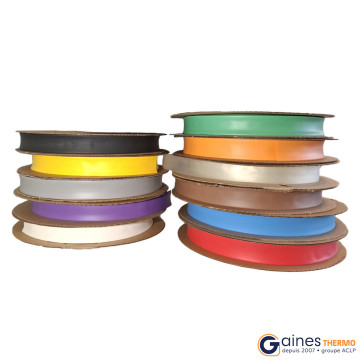
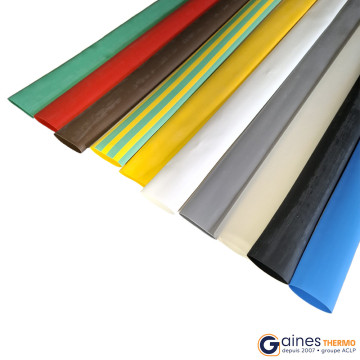
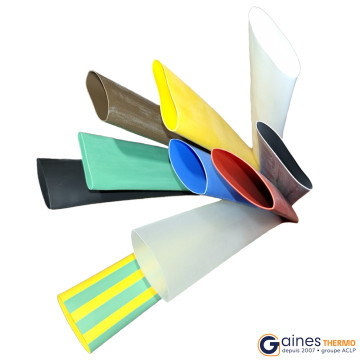
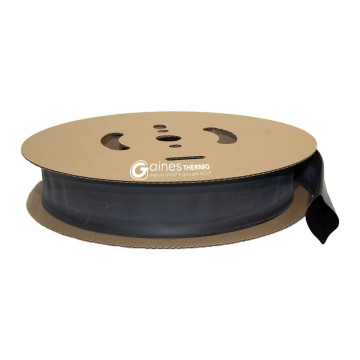
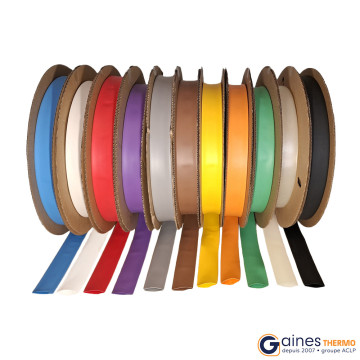
Polyolethin cross-linked is offered in multiple sizes (diameters 0.5 mm to more than 250 mm), thicknesses (wall thin, medium, thick) and ratios (2:1 standard, up to 6:1 for some special sheaths). It is found in 1M bar, 1.22 m bar, reel several tens of meters, even in matching kits or assortment boxes. The choice of colours is very broad (black, red, yellow, green, blue, transparent, brown, white, orange, yellow, grey, black, green/yellow, purple), allowing visual identification or colour code of the installations. In short, it is a plethora range that adapts to all scenarios.